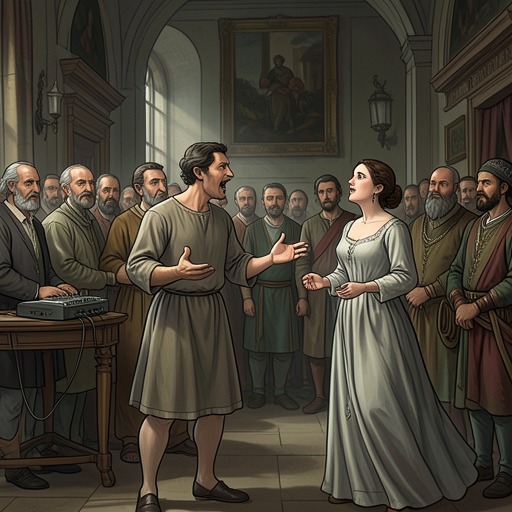
Madam Oretta
The DecameronMadam Oretta is a noble and well-spoken gentlewoman whose brief, deft reply turns a badly told story into a demonstration of wit. In the Sixth Day tale, she accepts a gentleman’s offer to carry her along with a story, then uses his own image of the ride to ask him to stop. Her courtesy preserves the company’s ease even as her words expose the gulf between a promising tale and its telling.
Identity and Setting
The narrator presents Madam Oretta as a woman of worth whose name deserves to be remembered. She is the wife of Messer Geri Spina and is spending a day in the countryside with a company of ladies and gentlemen. She has entertained them at her house for dinner; afterward, the party travels on foot from one place to another, and the way is long enough for conversation to become part of the diversion.
The story is introduced as an example of how a well-timed witty saying can silence a gentleman courteously. Its focus is not a contest over status or authority but the social skill of recognizing when an exchange has become tiresome and finding a graceful way to end it.
The Story and Its Failure
One of the gentlemen offers to carry Madam Oretta horseback for much of the journey by telling her one of the finest stories in the world. She welcomes the proposal. The story itself is good, but its delivery repeatedly breaks down: the gentleman repeats the same word, turns back to correct himself, misnames characters, and tells the incidents badly. His performance makes a promising tale difficult to follow.
As she listens, Madam Oretta feels so unwell from the disorder of the narration that she compares her distress to a swoon. When the storyteller becomes entangled in his own account, she intervenes with the line, “Sir, this horse of yours hath too hard a trot; wherefore I pray you be pleased to set me down.” The metaphor converts the gentleman’s promise into a comic measure of his failure: instead of carrying her smoothly through the journey, his story jolts her along.
Wit, Courtesy, and Narrative Role
Madam Oretta’s reply is pointed without being openly hostile. She does not dismiss the story’s subject or directly accuse the gentleman of speaking badly; she treats his offer as if it had literally made her his passenger and asks to dismount. The joke gives him a way to recognize the criticism without a public quarrel.
The gentleman understands the hint better than he has told the story. He takes the jest in good part, laughs, turns to other matters, and leaves his tale unfinished. Madam Oretta’s intervention thus changes the course of the conversation: the failed performance ends, but the social exchange remains companionable. Her momentary role in the narrative is small in duration yet decisive in effect, making her verbal timing—not the gentleman’s intended story—the scene’s successful entertainment.